
Strategic Initiative: Issuing JCM-Based Carbon Credits
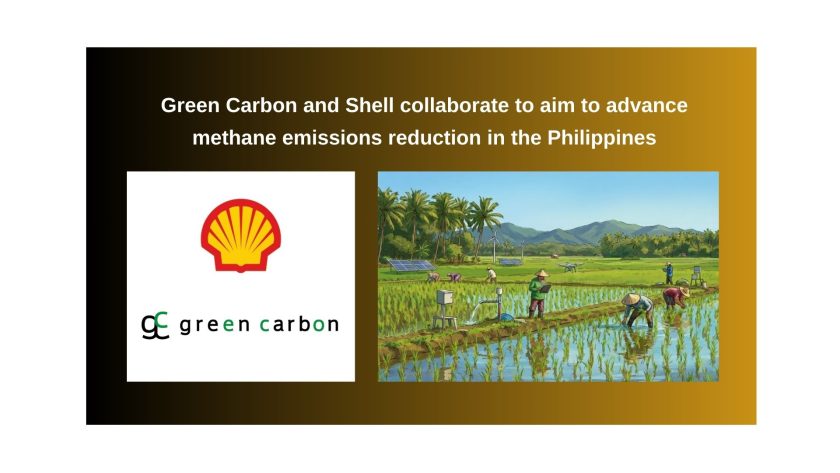
Green Carbon Inc. (CEP: Jun Okita; “Green Carbon”) and Shell Eastern Trading (Pte) Ltd. (“Shell”) have entered into a collaborative effort to support a project aimed at reducing methane emissions from rice paddies in Mindoro, Philippines. This initiative applies the Joint Crediting Mechanism (JCM) framework to deliver measurable climate benefits.
〇For inquiries regarding this press release and for further details, please contact
〇To download Green Carbon Co., Ltd.’s company profile, please visit
◆The JCM in Japan and Initiatives in the Agricultural Sector
The Joint Crediting Mechanism (JCM) is an international framework that enables Japan and partner nations to co-create greenhouse gas (GHG) reductions and share the resulting environmental benefits. This approach supports Japan’s climate roadmap, which targets significant emissions reductions by 2030 and beyond.
Historically focused on energy, the JCM is now expanding into agriculture, a sector with untapped potential for carbon credit generation. Among these efforts is a pioneering project in the Philippines, which aims to establish a model for agricultural JCM credits.
◆ Transforming Agriculture: Reducing Methane Emissions in the Philippines
Agriculture represents a critical decarbonization frontier in the Philippines, accounting for approximately 25% of the nation’s total GHG emissions (equivalent to roughly 54 million t-CO2)*1. Within this massive footprint, rice cultivation is the dominant driver. Methane emissions from rice paddies are identified as constituting more than half of these agricultural emissions*2, presenting a concentrated opportunity for high-impact intervention.
We are proud to deploy the Alternate Wetting and Drying (AWD) technique, a proven solution officially approved for JCM credit generation in partnership with the Philippines. The project shall be implemented with the “Methane Emission Reduction by Water Management in Rice Paddy Fields” (PH_AM004) methodology, a methodology which was approved by the Joint Committee for the JCM between the Philippines and Japan on 3 February 2025. This methodology was developed by the Expert Committee which consisted of members from Asian Development Bank (ADB), in collaboration with the Government of Japan’s Ministry of Agriculture, Forestry and Fisheries (JMAFF)
Addressing the critical challenge of methane emissions in agriculture, this method shifts away from methane-prone continuous flooding. Instead, it utilizes a controlled wet-dry cycle throughout the cultivation period to suppress gas generation effectively. The result is a substantial environmental benefit: an approximate 30% reduction in methane emissions*3.
This project stands as a beacon of innovation, holding the potential to lead the market by establishing a reliable pipeline for rice-based carbon credits.
◆Project Overview
The collaboration between Green Carbon and Shell focuses on deploying AWD across a targeted 50,000-hectare area in Mindoro. Green Carbon leads technical design and local farmer engagement, while Shell contributes investment to help scale sustainable operations. Together, both parties aim to enable the issuance of JCM credits and create pathways for commercial viability.
◆Corporate Initiatives: A Unified Force for Decarbonization
Green Carbon: The Architect of Market Value Green Carbon brings a robust portfolio of nature-based assets to the collaboration, ranging from forest conservation to biochar across Southeast Asia. In the Philippines, the company serves as the technical lead, structuring projects based on the cutting-edge JCM methodology approved in February 2025 . By aligning these efforts with Japan’s GX-ETS*4 —which now accepts JCM credits for ensuring corporate offsets—Green Carbon effectively bridges the gap between Philippine agriculture and the Japanese market, long-term economic viability.
Shell: Provides financial support to accelerate implementation and facilitate market access for high quality credits developed under the JCM methodology.
This partnership by the two industry leaders reflect a shared commitment to climate action and rural development, combining resources and expertise to advance decarbonization in agriculture and delivering measurable environmental restoration.
*1: Based on the 2020 GHG inventory. See Japan International Cooperation Agency (JICA), “The Final Report on the Data Collection Survey on Promoting Green Transformation (GX) Policies in the Republic of the Philippines” (March 2024).
*2: Based on the 2010 GHG inventory. See JICA, “The Final Report on the Data Collection Survey on Promoting Green Transformation (GX) Policies in the Republic of the Philippines” (March 2024).
*3: PhilRice Data https://www.philrice.gov.ph/ricelytics/main/province/49
*4: GX-ETS (Green Transformation-Emissions Trading Scheme). A system where companies reduce emissions and trade emission allowances under government-set caps, based on Japan’s “Growth-Oriented Carbon Pricing” concept.
◆ Green Carbon ,Inc.
Representative: Jun Okita, CEO
Head Office: PREX North 9F, 2-3-2 Kojimachi, Chiyoda-ku, Tokyo, Japan
Established: December 2019
Business Activities: Development and sales of carbon credits, agriculture-related projects, environmental projects, other related businesses, and ESG consulting
Website: https://green-carbon.co.jp/en/
◆ About Green Carbon
Guided by the vision of “Harnessing the power of life to save the Earth,” Green Carbon develops and supports projects that generate, register, and sell nature-based carbon credits both in Japan and abroad. The company is also engaged in agriculture-related businesses, R&D initiatives, and ESG consulting.
Its business activities span Japan, Southeast Asia, Australia, and South America, creating credits from rice paddies, biochar, forest conservation, carbon farming, mangrove planting, and cattle methane reduction. In Japan, Green Carbon obtained certification in FY2023 for the country’s first and one of the largest-scale rice paddy J-Credit projects (approx. 6,220 t). In FY2024, the company plans to expand this initiative to around 40,000 ha (approx. 80,000 t).
Green Carbon also provides “Agreen,” a one-stop platform service that streamlines the entire process of credit registration, application, and sales. By simplifying procedures and documentation, the service reduces the administrative burden on credit creators.
◆Green Carbon’s social media
Youtube :https://www.youtube.com/channel/UCYO4WnGOHDaVB1ikxheZasA
note :https://note.com/green_carbon/
Facebook:https://www.facebook.com/profile.php?id=61557429326458
X :https://mobile.x.com/GreenCarbon2019
Linkedin :https://www.linkedin.com/company/green-carbon-inc/
Wantedly:https://www.wantedly.com/companies/greencarbon2019