
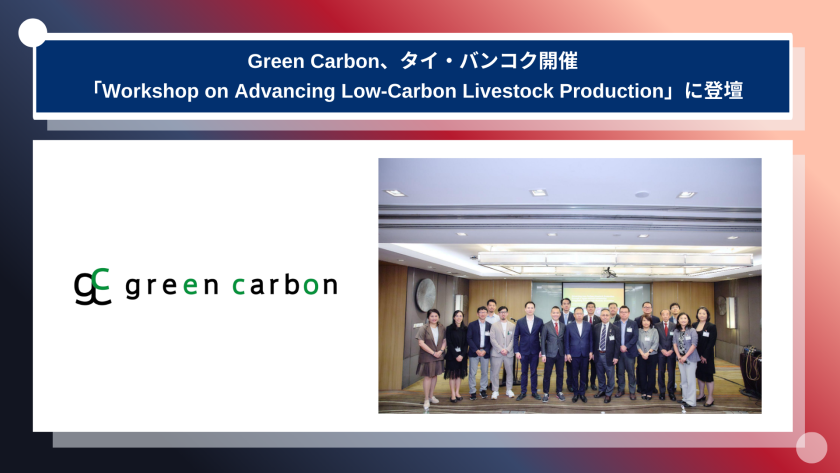
Introducing Japan’s Livestock Methane Reduction Projects to ASEAN
Green Carbon Co., Ltd. (CEO: Jun Okita, hereinafter “Green Carbon”), a company engaged in the creation and sale of nature-based carbon credits, participated as a speaker at the international workshop “Advancing Low-Carbon Livestock Production through a Japan–ASEAN Partnership” (hereinafter “the Workshop”), held in Bangkok, Thailand on March 2, 2026. At the event, the company presented practical case studies on reducing livestock-related greenhouse gas emissions in Japan.
The Workshop was held to discuss the implementation and commercialization potential of low-carbon livestock systems through collaboration among academia, industry, and government across Japan and the ASEAN region. Participants included research institutes, universities, food and feed companies, trading firms, and government representatives.
〇For inquiries regarding this press release or for further information, please contact
○Download Green Carbon’s Company Profile
◆ Decarbonization of the Livestock Sector: A Growing Global Priority
According to estimates by the Food and Agriculture Organization of the United Nations (FAO) and analyses by several international institutions, emissions from livestock account for approximately 10–20% of global greenhouse gas emissions. A large portion of these emissions comes from methane produced during cattle digestion (so-called enteric methane, commonly referred to as methane from “burping”) as well as methane generated through manure management.
Methane (CH₄) has a significantly stronger short-term warming impact than CO₂, making it a priority target for reduction in climate change mitigation efforts. At the same time, studies suggest that the livestock sector still holds considerable potential for emissions reductions through improvements such as enhanced feed efficiency and advanced manure management practices.
During the workshop, participants discussed scientific research findings and commercialization opportunities related to low-carbon livestock production in both Japan and the ASEAN region.
◆ Addressing Climate and Agricultural Challenges
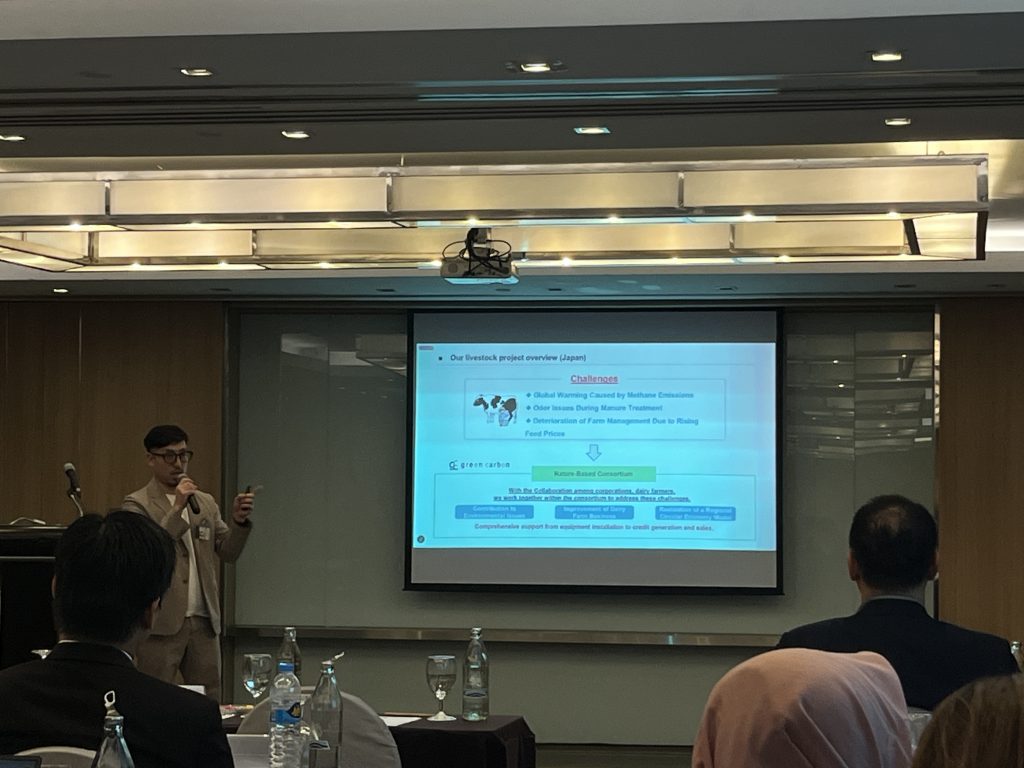
Green Carbon delivered a presentation titled “Financing Livestock GHG Emission Reduction through Offsetting and Insetting – Japan Case Studies,” introducing its livestock methane reduction projects currently being implemented in Japan.
These projects utilize the Japanese government’s methodology AG-002 (Changes in Livestock Manure Management Practices). Through the introduction of forced fermentation systems and other improved manure management technologies, the projects aim to reduce methane and nitrous oxide emissions.Each cow is estimated to enable emissions reductions of approximately 2 t-CO₂ per year. In 2025, the company applied for the issuance of approximately 7,000 t-CO₂ worth of carbon credits, and plans to generate around 20,000 t-CO₂ in 2026.
In addition to introducing technical mitigation approaches, the presentation also explained the financial structures required to sustainably scale emissions reduction projects, including mechanisms for demand creation under Japan’s GX-ETS (emissions trading system), aggregation models to support small-scale farmers, and financing schemes developed in collaboration with investors.
◆ From Manure Management to Enteric Methane Reduction
In this presentation, we introduced implementation cases of offset-based projects targeting livestock manure management. At the same time, we are also advancing discussions on addressing methane emissions from enteric fermentation in cattle, which account for the majority of livestock-related emissions, as an important future reduction target.
In Japan, a new methodology under the J-Credit Scheme, “AG-007,” has recently been established to address methane emissions from enteric fermentation. This methodology is expected to enable emissions reductions through approaches such as advanced feed formulation and the use of methane-reducing feed additives.
Our company is exploring the potential application of these new methodologies while also considering combinations with supply chain emission reductions (insetting) for corporate partners. Through these efforts, we are working toward the development of a comprehensive methane reduction model for the livestock sector.
By addressing both manure management and enteric methane emissions, we aim to further reduce greenhouse gas emissions in the livestock sector and contribute to the realization of sustainable livestock production.
◆ Expansion Potential in the ASEAN Region
In ASEAN countries such as Thailand, discussions around emissions trading systems and international carbon credit mechanisms (including JCM and Article 6) are progressing.Building on its policy-linked agricultural carbon model developed in Japan, Green Carbon is exploring opportunities to expand initiatives that simultaneously reduce greenhouse gas emissions in the livestock sector and improve farmers’ economic sustainability across ASEAN.
◆Green Carbon, Inc.
Representative: Jun Okita, CEO
Head Office: PREX North 9F, 2-3-2 Kojimachi, Chiyoda-ku, Tokyo, Japan
Established: December 2019
Business Activities: Development and sales of carbon credits, agriculture-related projects, environmental projects, other related businesses, and ESG consulting
Website: https://green-carbon.co.jp/en/
◆About Green Carbon
Guided by the vision of “Harnessing the power of life to save the Earth,” Green Carbon develops and supports projects that generate, register, and sell nature-based carbon credits both in Japan and abroad. The company is also engaged in agriculture-related businesses, R&D initiatives, and ESG consulting. Its business activities span Japan, Southeast Asia, Australia, and South America, creating credits from rice paddies, biochar, forest conservation, carbon farming, mangrove planting, and cattle methane reduction. In Japan, Green Carbon obtained certification in FY2023 for the country’s first and one of the largest-scale rice paddy J-Credit projects (approx. 6,220 t). In FY2024, the company plans to expand this initiative to around 40,000 ha (approx. 80,000 t). Green Carbon also provides “Agreen,” a one-stop platform service that streamlines the entire process of credit registration, application, and sales. By simplifying procedures and documentation, the service reduces the administrative burden on credit creators.
◆Green Carbon’s social media
Carbon Credits Journal:https://biz-journal.jp/carboncredits/
Linkedin :https://www.linkedin.com/company/green-carbon-inc/
Facebook:https://www.facebook.com/profile.php?id=61557429326458
X :https://mobile.x.com/GreenCarbon2019
Wantedly:https://www.wantedly.com/companies/greencarbon2019
Youtube :https://www.youtube.com/channel/UCYO4WnGOHDaVB1ikxheZasA
note :https://note.com/green_carbon/