
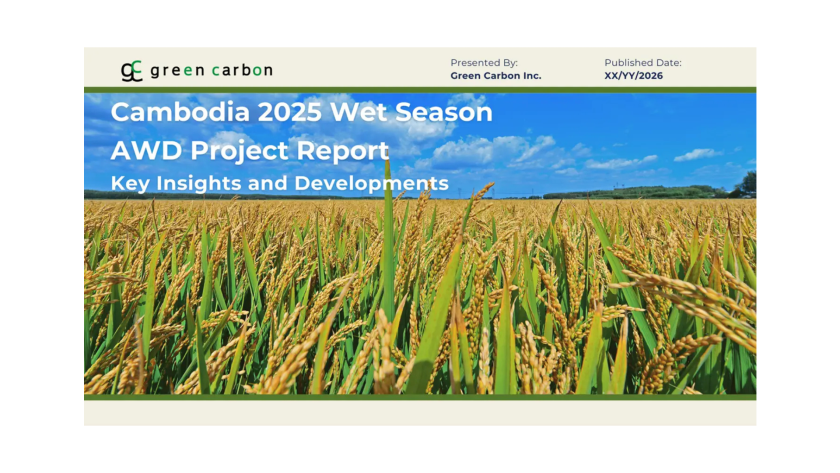
Positive Impacts Confirmed, Including a 77% Reduction in Methane Emissions, Increased Crop Yields, and Reduced Water Use | Project Expansion to 20,000 ha Planned by 2026
Green Carbon Inc. (CEO: Jun Okita; hereafter “Green Carbon”), a company operating one of the largest nature-based carbon credit generation and sales businesses in Japan, is implementing Cambodia’s largest Alternate Wetting and Drying (AWD※1) project (hereafter “the Project”) in Battambang Province in northwestern Cambodia. The Project is being carried out in collaboration with the Royal University of Agriculture (RUA), the Ministry of Agriculture, Forestry and Fisheries (MAFF), and local government partners.
We are pleased to announce the public release of the Cambodia 2025 Wet Season AWD Project Report, which summarizes the positive impacts achieved through the Project, including reductions in methane emissions, increased crop yields, and reduced water consumption. The report is available free of charge.
〇Download the Full Report here (Japanese)
〇Download the Full Report here (English)
〇Contact Us for More Information here
◆Report Overview
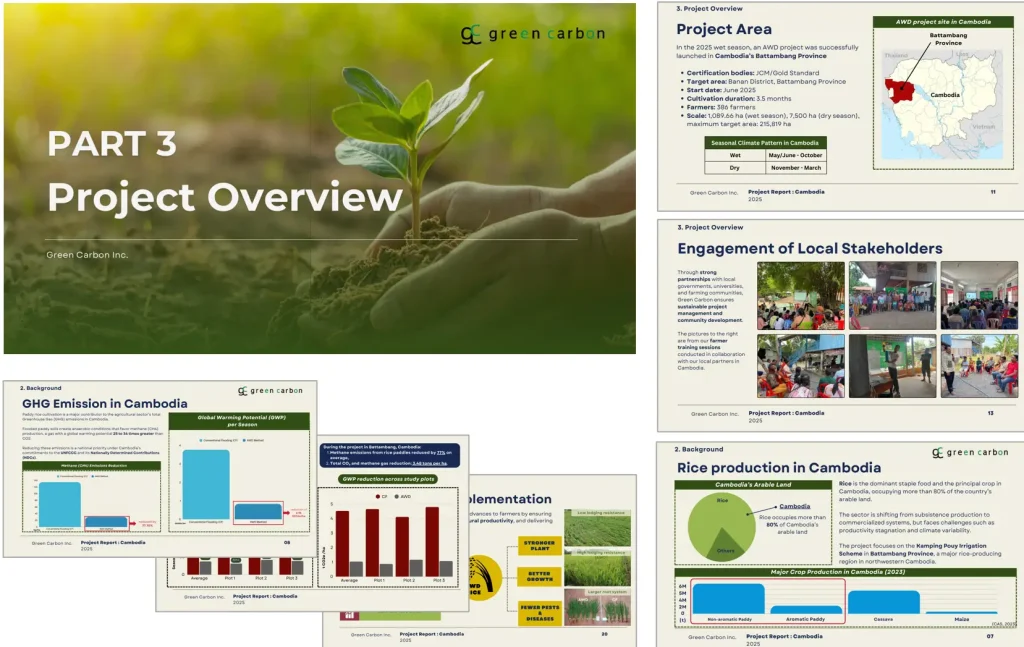
〇Report Snapshots
| Table of Contents | Key Highlights |
|---|---|
| Part① | Company Overview – About Green Carbon Inc. |
| Part② | Market Environment and Greenhouse Gas Emissions in Cambodia |
| Part③ | Project Overview |
| Part④ | Impacts and Results of AWD Implementation During the 2025 Wet Season |
| Part⑤ | Green Carbon’s Partnerships and Collaborations in Cambodia |
| Part⑥ | Future Outlook |
◆Project Overview
Green Carbon is engaged in the development of nature-based carbon credit projects primarily across Southeast Asia. The company implements a wide range of initiatives, including forest conservation, sustainable rice cultivation, mangrove restoration, enteric methane reduction from livestock, and biochar projects. By developing carbon credit projects tailored to the characteristics of local natural resources and utilizing satellite data for site selection and monitoring, Green Carbon achieves efficient and highly transparent project management.
Since April 2024, Green Carbon has participated as a collaborating organization in the SATREPS (Science and Technology Research Partnership for Sustainable Development) project led by the Japan International Research Center for Agricultural Sciences (JIRCAS). This project aims to develop and implement technologies to reduce greenhouse gas emissions through the establishment of sustainable rice paddy management systems in Cambodia.
In addition, since October 2024, Green Carbon has been conducting joint research with the Royal University of Agriculture (RUA), implementing pilot demonstrations in Battambang Province. The project is expected to generate approximately 10 million tons of carbon credits over a 10-year period. This initiative represents the first effort by a Japanese company to implement a rice paddy methane reduction project in Cambodia, serving as an advanced example of integrating sustainable agriculture with climate change mitigation.
Through the utilization of the Joint Crediting Mechanism (JCM※2) and certification schemes such as Gold Standard, Green Carbon promotes sustainable agriculture and carbon credit generation through Nature-based Solutions (NbS).
During the 2025 wet season, the project was implemented across 1,089.66 hectares with the cooperation of 386 local farmers. Following the completion of the pilot phase, Green Carbon plans to significantly expand the project to approximately 20,000 hectares by 2026.
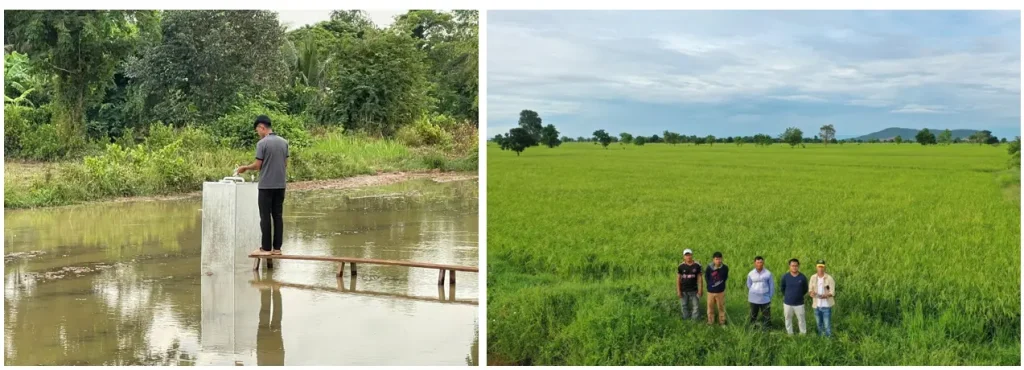
〇AWD Implementation in Cambodia
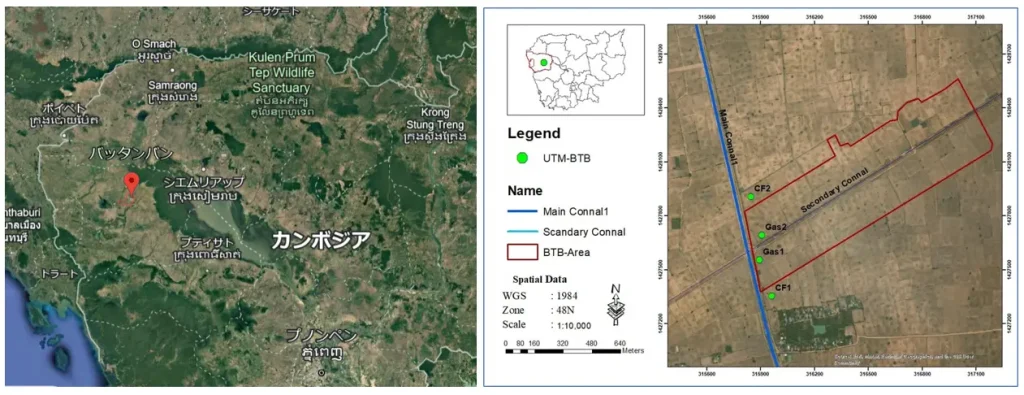
〇Battambang Province, Northwestern Cambodia
◆Impacts of AWD Implementation
In this project, Alternate Wetting and Drying (AWD) was introduced to rice paddy fields, challenging the conventional perception that sustainable farming practices require sacrificing crop yields.
Compared with conventional Continuous Flooding (CF) practices, the project demonstrated the following positive impacts:
| Category | Impact |
|---|---|
| Water Savings | Water use was reduced by 39.3% (from 16,150 m³/ha to 10,850 m³/ha), demonstrating highly efficient water utilization and effectiveness even under conditions of water scarcity. |
| Labor and Economic Optimization | The number of irrigation cycles was reduced from 11 to 7, contributing to significant cost savings in labor, fuel, and electricity for pumping and irrigation operations. |
| Yield Improvement | Despite reduced water use, healthy rice growth with improved lodging resistance was observed, resulting in a 3.77% increase in yield (from 5,011 kg/ha to 5,200 kg/ha). |
| Methane Emissions Reduction | A 77.07% reduction in CO₂-equivalent emissions was confirmed, corresponding to a reduction of 3.48 tCO₂e per hectare. |
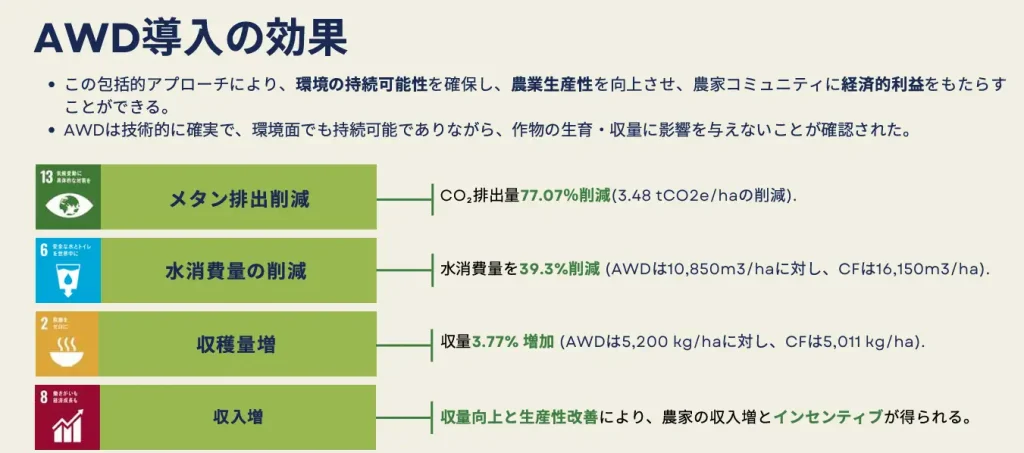
〇本レポートより抜粋
◆Project Structure
To translate the data and insights obtained through this project into transformational change and sustainable implementation in Cambodia, Green Carbon established an integrated partnership model in collaboration with research institutions and local partners.
Green Carbon led the overall project management, farmer training programs, and carbon credit development, while advancing the project through partnerships with the following organizations:
| 【Royal University of Agriculture (RUA)】 |
|---|
| Role: Responsible for scientific verification. A specialized research team conducted weekly gas sampling in the test plots, and precise analysis using gas chromatography was carried out at RUA laboratories to quantify emission reductions. |
| 【Provincial Department of Agriculture, Forestry and Fisheries (PDAFF)】 |
|---|
| Role: Responsible for coordination at the regional level, leading project preparation, stakeholder meetings, and the promotion of farmer participation. |
| 【Ministry of Agriculture, Forestry and Fisheries (MAFF)】 |
|---|
| Role: Provided policy support at the national level and a regulatory framework for climate-smart agriculture, ensuring alignment with national climate targets. |
| 【Water User Associations (WUAs)】 |
|---|
| Role: Responsible for on-site implementation and efficient water management through the coordination of irrigation schedules within the Kamping Puoy irrigation scheme. |
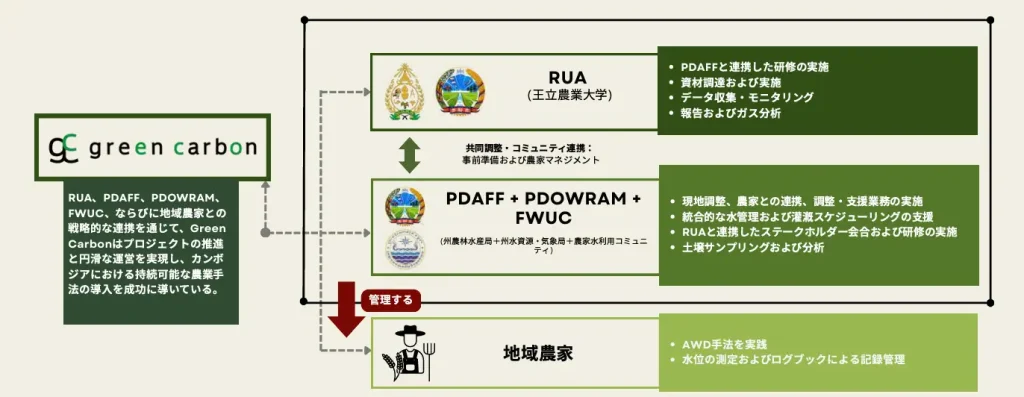
〇プロジェクト運営/共同体制
◆Project Management and Partnership Structure
Building on the significant results achieved during the 2025 wet season and the strong positive feedback from participating farmers, Green Carbon plans to expand the project area from 1,089.66 hectares to approximately 20,000 hectares by 2026.
During the 2026 expansion phase, the project will extend beyond Battambang Province to include four additional provinces in the Mekong River basin and surrounding the Tonle Sap Lake area: Takeo, Prey Veng, Pursat, and Kampong Thom. By collaborating with thousands of local farmers, Green Carbon aims to promote environmentally sustainable agricultural practices that simultaneously reduce costs and increase yields, contributing to higher farmer incomes and the dissemination of sustainable farming knowledge.
Furthermore, Green Carbon plans to expand the project in Battambang Province alone to approximately 30,000 hectares by 2027, with the goal of achieving a cumulative reduction of 10 million tons of CO₂e emissions and generating carbon credits over the next ten years.
※1 Alternate Wetting and Drying (AWD)
A rice paddy water management method in which irrigation and natural drying are alternated every few days based on field water levels. Compared with continuous flooding, Alternate Wetting and Drying (AWD) can significantly reduce water use and contribute to the conservation of water resources.
※2 Joint Crediting Mechanism (JCM)
The Joint Crediting Mechanism (JCM) is a bilateral framework through which Japan and partner countries cooperate to reduce and remove greenhouse gas emissions. The quantified emission reductions and removals are shared between the participating countries. In Japan, the verified reductions and removals can be utilized as carbon credits. The Japanese government has set targets to secure approximately 100 million t-CO₂ of carbon credits by FY2030 and approximately 200 million t-CO₂ by FY2040 on a cumulative basis.
◆Green Carbon Inc.
Representative : Jun Okita, Representative Director (CEO)
Head Office : 9F, Hanzomon PREX North, 2-3-2 Kojimachi, Chiyoda-ku, Tokyo, Japan
Established : December 12, 2019
Business Activities: Carbon credit generation and sales; agriculture-related businesses; environmental-related businesses; other related operations; and ESG consulting services.
URL : https://green-carbon.co.jp/
◆About Green Carbon
Guided by the vision of “Harnessing the power of life to save the Earth,” Green Carbon develops and supports projects that generate, register, and sell nature-based carbon credits both in Japan and abroad. The company is also engaged in agriculture-related businesses, R&D initiatives, and ESG consulting. Its business activities span Japan, Southeast Asia, Australia, and South America, creating credits from rice paddies, biochar, forest conservation, carbon farming, mangrove planting, and cattle methane reduction. In Japan, Green Carbon obtained certification in FY2023 for the country’s first and one of the largest-scale rice paddy J-Credit projects (approx. 6,220 t). In FY2024, the company plans to expand this initiative to around 40,000 ha (approx. 80,000 t). Green Carbon also provides “Agreen,” a one-stop platform service that streamlines the entire process of credit registration, application, and sales. By simplifying procedures and documentation, the service reduces the administrative burden on credit creators.
◆Green Carbon’s social media
Carbon Credits Journal:https://biz-journal.jp/carboncredits/
Linkedin :https://www.linkedin.com/company/green-carbon-inc/
Facebook:https://www.facebook.com/profile.php?id=61557429326458
X :https://mobile.x.com/GreenCarbon2019
Wantedly:https://www.wantedly.com/companies/greencarbon2019
Youtube :https://www.youtube.com/channel/UCYO4WnGOHDaVB1ikxheZasA
note :https://note.com/green_carbon/