
~Utilising the JCM to reduce methane emissions by 964,000 tonnes over 10 years. Collaborating with farmers, government and universities to establish a decarbonised rice cultivation model covering 25,000 hectares~
Green Carbon Inc. (CEO: Jun Okita, hereinafter “Green Carbon”), which develops a nature-based carbon credit generation and sales business, has launched a methane reduction project (hereinafter “the Project”) in rice paddies in Negros Province, the Philippines, in collaboration with FCC Co., Ltd. (President and Representative Director: Yoshinori Saito; hereinafter “FCC”). The Project utilizes alternate wetting and drying (AWD) (※1)
This project applies the JCM (Joint Crediting Mechanism) (※2) promoted by the Japanese government. It will be implemented in collaboration with the local government, agricultural organisations, universities, and farmer networks, commencing with 100 hectares in the first year and with the potential to expand to a maximum of 25,000 hectares. This initiative is projected to achieve cumulative greenhouse gas reductions of 964,251 tonnes of CO₂ equivalent over a ten-year period.
〇For inquiries regarding this press release and for further details, please contact
〇To download Green Carbon Co., Ltd.’s company profile, please visit
◆Background to This Collaboration
Green Carbon operates under the vision of “Save the earth with the power of nature”, providing end-to-end support for the creation, registration and sale of carbon credits. Centred on Southeast Asia, we engage in diverse nature-based carbon credit generation projects including forest conservation, rice field methane reduction, biochar, livestock manure reduction, mangrove planting and carbon farming.
Furthermore, FCC is committed to reducing environmental impact within the mobility sector as an automotive parts manufacturer, while simultaneously strengthening its response to climate change, a global challenge. The company is actively expanding its operations in the Asian region, with FCC (PHILIPPINES) CORP. in particular having collaborated with the local community and built trust for over 30 years since establishing its base in 1993. Moving forward, FCC aims to realise a sustainable future based on partnerships with the region.
As part of this initiative, we commenced our collaboration in November 2025.
◆Characteristics of Negros Island
Negros Island is situated in the Western Visayas region of the central Philippines, comprising Negros Occidental Province to the west and Negros Oriental Province to the east. It possesses fertile volcanic soil and extensive alluvial plains, where the cultivation of rice, sugarcane, and maize has flourished since ancient times. Of its approximately 280,000 hectares of farmland, 60,000 to 65,000 hectares are utilised as paddy fields. The climate is tropical monsoon, relatively less affected by typhoons, providing an environment conducive to stable rice cultivation throughout the year.
The province is dotted with major rice-growing areas such as Bago, La Carlota, Kabankalan, and Hinigaran, where irrigation infrastructure is extensively developed. However, as continuous flooding for cultivation has historically been the norm, challenges have become apparent, including increased methane emissions, water resource constraints during the dry season, and declining soil organic matter.
Against this backdrop, the Provincial Agricultural Office (PAO) has identified climate change as ‘the greatest threat to local agriculture’. It is establishing a support framework encompassing both technology adoption and productivity enhancement, including implementing climate adaptation strategies in collaboration with UK government agencies and promoting training in climate-smart farming practices through agricultural extension officers.
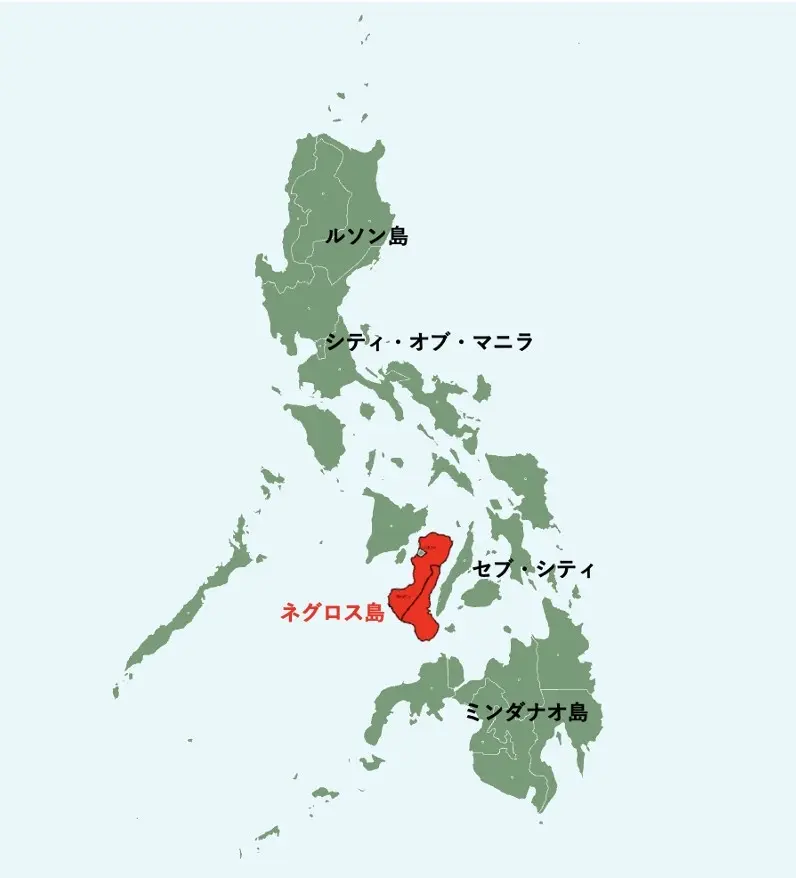
○Negros Island’s location
Whilst these challenges exist, this region also presents exceptionally favourable conditions for introducing AWD, making it possible to simultaneously achieve water savings, reduced emissions, and increased productivity through AWD.
| robust support system | The provincial government (LGU), agricultural extension officers, the National Irrigation Administration (NIA), and organised irrigation associations (IA) are working in close collaboration, ensuring smooth farmer mobilisation and monitoring. |
| Irrigation infrastructure | The existing irrigation network is already in place, making it easy to introduce water management farming techniques (AWD). |
| Technology Acceptance | Farmers have a proven track record of actively adopting mechanisation, improved varieties, and climate-adaptive farming methods. |
| The value of water-saving benefits | During the dry season, water shortages arise due to competition for water demand with other sectors. The water-saving effects achieved through AWD have a greater economic and environmental impact compared to other states where water pressure issues are less prevalent. |
Moreover, the province is a major rice-producing area within the Western Visayas region, where improvements in water use efficiency and climate change adaptation directly impact regional food security. For these reasons, Negros Island is recognised as a region possessing significant scale advantages and deployment potential, capable of simultaneously achieving methane reduction through AWD implementation, enhanced water use efficiency, and increased farmer income.
◆Details of This Initiative
This project will reduce annual emissions by 5.03 tonnes of CO₂ equivalent per hectare by switching from conventional continuous flooding to alternate wetting and drying (AWD). This equates to a total reduction of approximately 960,000 tonnes of greenhouse gases over ten years, contributing to emissions reductions in both Japan and the Philippines. The introduction of AWD offers more than just environmental benefits. Existing field trials have confirmed that it reduces water usage by an average of 38%, increases yields by 5–16%, and leads to a reduction in pesticide application.
AWD is a technology that could become the next standard in Philippine rice cultivation, simultaneously achieving productivity gains, cost reductions and climate contributions.
Green Carbon is already advancing collaboration with mayors in the target areas, the Provincial Agriculture Office (PAO), the Municipal Agriculture Office (MAO), and partner universities such as Central Philippines State University.
<About Central Philippines State University (CPSU)>
Central Philippines State University (CPSU) is a state university headquartered in Cabankalan City, Negros Occidental, Philippines. It was established from its predecessor, the Negros Occidental Agricultural School, and following subsequent institutional reforms, was elevated to a state comprehensive university in 2012. With its background rooted in development as an agricultural education institution, it possesses strengths in practical education and research centred on agriculture, animal husbandry, forestry, fisheries, and environmental science.
The university owns approximately 4,653 hectares of land, utilised as educational and research facilities for agriculture, forestry, and natural resource management. It actively engages with the local community, undertaking educational, extension, and research activities in collaboration with government bodies, private sector organisations, local authorities, and community groups. These efforts address challenges in Negros Province, including the promotion of sustainable agriculture, human resource development, and adaptation to climate change.
◆Future Prospects
This project will commence with an initial 100 hectares in time for the January 2026 planting season. Following verification, it will be expanded in phases, ultimately aiming for implementation across 25,000 hectares. Building upon the framework established here, we plan to extend the initiative to other regions within the Philippines. By scientifically demonstrating the greenhouse gas reduction benefits achieved through the adoption of AWD technology, we will communicate the effectiveness of climate change countermeasures in the agricultural sector both domestically and internationally.
Furthermore, by further strengthening our collaborative framework with local farmers, municipalities, and academic institutions, we will advance the development of sustainable agricultural models beyond merely generating carbon credits. This approach will achieve both regional economic development and environmental conservation, while also contributing to a stable supply for the international carbon credit market.
Furthermore, looking ahead, we envisage expanding beyond the Philippines, particularly into Southeast Asian nations. Through the introduction of AWD and the generation of credits across Asia, we aim to play a part in international efforts to mitigate climate change.
※1:Alternate Wetting and Drying (AWD)
Alternate Wetting and Drying (AWD) is a technique that involves repeatedly flooding and allowing natural drying of paddy fields every few days, using the water level as a guide. Compared to continuous flooding, AWD reduces water usage and contributes to the conservation of water resources.
※2:Joint Crediting Mechanism(JCM)
A system whereby Japan and partner countries collaborate on greenhouse gas reduction and absorption efforts, sharing the quantified reduction and absorption amounts between the two nations. Japan can utilise these quantified reduction and absorption amounts as carbon credits. The Japanese government has set targets to secure approximately 100 million t-CO2 in cumulative carbon credits by fiscal year 2030 and approximately 200 million t-CO2 by fiscal year 2040.
◆ Green Carbon ,Inc.
Representative: Jun Okita, CEO
Head Office: PREX North 9F, 2-3-2 Kojimachi, Chiyoda-ku, Tokyo, Japan
Established: December 2019
Business Activities: Development and sales of carbon credits, agriculture-related projects, environmental projects, other related businesses, and ESG consulting
Website: https://green-carbon.co.jp/en/
◆F.C.C. Co.,Ltd.
Representative:Yoshitaka Saito, President and Representative Director
Head Office:7000-36, Nakagawa, Hosoe-cho, Hamana-ku, Hamamatsu-shi, Shizuoka 431-1394, Japan
Established:June, 1939
Business Activities:
Motorcycle business: Manufacture and sale of clutches for motorcycles, scooters, ATVs (baby carriages), etc., and products in the EV/CASE field
Four-wheeled vehicle business: Manufacture and sale of clutches for manual transmission vehicles, automatic transmission vehicles, etc., and products in the EV/CASE field
Non-mobility business: Manufacture and sale of products and provision of services in the environmental and energy fields, etc.
Website: https://www.fcc-net.co.jp/en/
◆ About Green Carbon
Guided by the vision of “Harnessing the power of life to save the Earth,” Green Carbon develops and supports projects that generate, register, and sell nature-based carbon credits both in Japan and abroad. The company is also engaged in agriculture-related businesses, R&D initiatives, and ESG consulting.
Its business activities span Japan, Southeast Asia, Australia, and South America, creating credits from rice paddies, biochar, forest conservation, carbon farming, mangrove planting, and cattle methane reduction. In Japan, Green Carbon obtained certification in FY2023 for the country’s first and one of the largest-scale rice paddy J-Credit projects (approx. 6,220 t). In FY2024, the company plans to expand this initiative to around 40,000 ha (approx. 80,000 t).
Green Carbon also provides “Agreen,” a one-stop platform service that streamlines the entire process of credit registration, application, and sales. By simplifying procedures and documentation, the service reduces the administrative burden on credit creators.
◆Green Carbon’s social media
Youtube :https://www.youtube.com/channel/UCYO4WnGOHDaVB1ikxheZasA
note :https://note.com/green_carbon/
Facebook:https://www.facebook.com/profile.php?id=61557429326458
X :https://mobile.x.com/GreenCarbon2019
Linkedin :https://www.linkedin.com/company/green-carbon-inc/
Wantedly:https://www.wantedly.com/companies/greencarbon2019